
Every screening workflow starts with the same question: who is on the other side? Blockchain analytics answers it with attribution, clustering and entity labels built up over years. AI agents add a new kind of counterparty. They hold wallets, pay for data and services on their own, and their number is growing fast: in our index of the on-chain agent registry on Base, new registrations grew around six-fold between July and September.
Sooner or later, the banks, exchanges and agencies that rely on analytics providers will ask whether a given address belongs to an agent, and who stands behind it. That's a question of AI agent identity, and on-chain, part of the answer is public. We've spent the past months indexing agent registries while building x402 Radar. Here's what they give you, where they fall short, and the product decisions they force.
Know Your Agent (KYA) means checking an AI agent before trusting it: linking it to the person or company responsible for it, and to what it's allowed to do. It's the agent counterpart of KYC.
Most KYA today happens when an agent interacts. Skyfire's KYAPay, for example, gives agents a signed token that merchants verify before accepting a payment.
That covers the moment of the transaction. This post is about the other side: Know Your Agent on-chain, where an agent's identity, ownership and history are public.
ERC-8004 is a draft Ethereum standard for AI agent identity. It lets agents register on-chain with an owner, a wallet and a public reputation. It's the biggest source of agents we've found, at least on some chains.
Through ERC-8004, each agent has:
All of it changes over time. x402 Radar tracks seven kinds of registry events: registrations, wallet changes, ownership transfers, metadata updates, feedback, responses to feedback and revocations of feedback.
There's no single list of AI agents. We also follow service catalogs, such as Coinbase's Bazaar. Each source works differently and covers a different slice of the ecosystem.
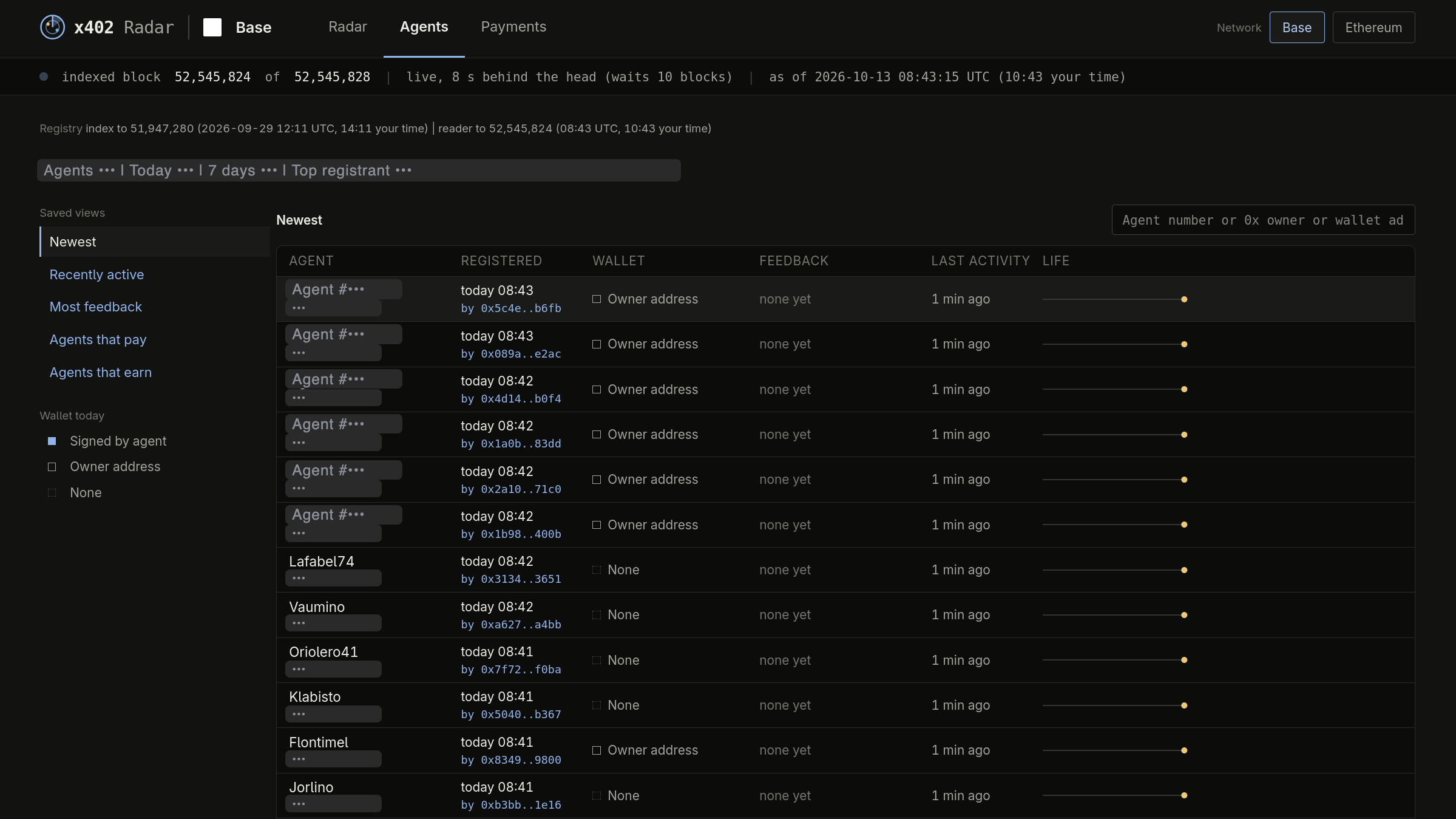
Our index is still early, so we're not publishing totals. Nobody has a complete picture of agent activity today, us included. But a few patterns are clear enough to shape how a product should model agents.
A single address can register thousands of agents. We can't rule out that some of it is test activity. Either way, it's a cluster an entity model has to know about.
Among the newest registrations we looked at, agents pointed either to their owner's address or to no wallet at all. When an agent pays from its owner's address, agent activity and owner activity sit on the same address.
Until recently, ownership transfers were rare. Since mid-October, we've seen agents registered by fresh addresses and given away a few minutes later. We'll look at this more closely in a follow-up.
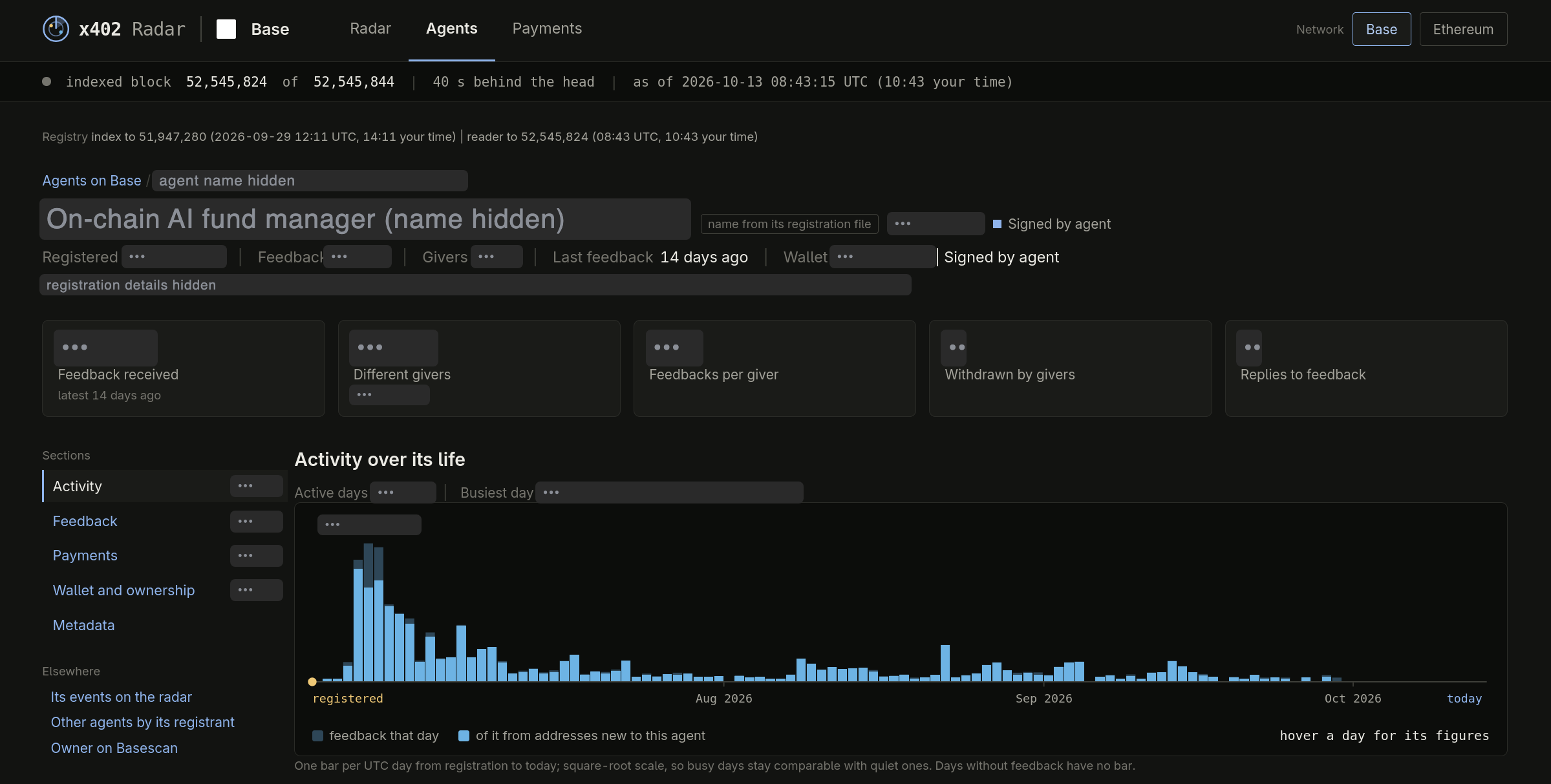
Feedback in the registry comes from addresses, and new addresses cost nothing. One party can leave many reviews from fresh wallets, a classic Sybil pattern. We've seen an agent describing itself as an on-chain AI fund manager collect thousands of pieces of feedback, much of it in one spike after registration, many of them from addresses that had never interacted with it, without making a single payment. Feedback is also rarely withdrawn once given. ERC-8004 is still a draft, and this part of the standard is under active discussion, so it may get stronger.
An empirical study of the ERC-8004 ecosystem reached a similar conclusion: on Base, more than 90% of reviewers were linked to coordinated Sybil clusters, and the authors concluded that the reputation registry, as currently deployed, cannot function as a trust signal.
For compliance teams, AI agents add a new question to every check: is this address an agent, and who is accountable for it? If your customers start asking about agents, "add a new data source" isn't the whole answer. A few decisions come first:
To support those decisions, the data has to cover at least:
How this is built in practice, from finding agents to classifying their payments, is in our technical guide to x402 payments on-chain.
x402 Radar covers these today to varying degrees. It runs on our own indexer on Base, Ethereum and Polygon, with more networks next, including non-EVM chains. For any agent, it shows who registered and owns it, which wallet it uses, how its reputation formed and what it has paid.
It can be delivered via API or deployed in your own stack, and we can build the same capability together with your team. It comes from the same team that has built blockchain data infrastructure for Elliptic for the past five years.
Know Your Agent (KYA) means checking an AI agent before trusting it: linking it to the person or company responsible for it, and to what it's allowed to do. Off-chain, that usually happens at the moment of a transaction. On-chain, it relies on public registry data such as ERC-8004.
ERC-8004 is a draft Ethereum standard for AI agent identity. Agents register on-chain with a registrant, an owner, a wallet, a self-declared registration file and public feedback from other addresses. Agents can be transferred, so all of it changes over time.
Not fully from on-chain data alone. What you can see is who registered an agent, who owns it now and who owned it at any past block, which wallet it pays from and how its reputation formed. Names and descriptions are self-declared, so they need checking against the agent's behavior.
Not on its own, at least not yet. Feedback comes from addresses, and new addresses cost nothing, so one party can leave many reviews from fresh wallets. An empirical study of ERC-8004 found that on Base more than 90% of reviewers were linked to coordinated Sybil clusters. Raw feedback counts need pattern analysis before they're used in any risk score.
The address that currently controls the agent in the registry. It isn't always the address that registered it, and ownership can be transferred, sometimes minutes after registration. For any payment, what matters is who owned the agent at that block, not today.
AI agents hold wallets and pay on their own. Analytics and compliance teams need to know whether an address belongs to an agent and who is accountable for it at the time of each transaction, and today's agent registries don't answer that on their own.
Want to see what the agents on your customers' radar look like? Book a 20-minute demo of x402 Radar →

