
.jpg)
A plain ERC-20 token will happily let anyone send it anywhere. For a regulated asset, that is not a feature, it is a compliance breach waiting to happen. Issuers need to control precisely who can hold, receive, or transfer the asset at any given moment, and ERC-3643 is the token standard built for exactly that. [1]
ERC-3643, also known as T-REX (Token for Regulated EXchanges), is a permissioned Ethereum token standard that embeds identity verification and programmable compliance rules directly into the smart contract layer, so every transfer is automatically checked against investor eligibility, jurisdiction, and regulatory criteria before it executes.[2][1]
The standard reached “Final” status as an Ethereum Improvement Proposal, making it the first standard for permissioned, regulated securities to achieve that designation from the Ethereum community. That matters for anyone evaluating erc3643 as infrastructure: it is not an experimental framework but a finalized, audited specification with a growing implementation ecosystem.[3][1]
ERC-3643 is a permissioned token standard: unlike ERC-20, where any wallet can receive tokens as long as it has a valid address, ERC-3643 tokens only move between wallets that satisfy identity and eligibility conditions defined by the issuer. The standard is the technical foundation of the T-REX protocol, an open-source suite of smart contracts for issuing, managing, and transferring permissioned tokens.[4][1]
Architecturally, the erc3643 token standard extends ERC-20 rather than replacing it — the token contract still exposes transfer(), balanceOf(), and related functions, but every transfer call is intercepted by identity and compliance checks before the underlying balance update executes. This gives issuers the wallet-level compatibility of ERC-20 combined with an enforcement layer purpose-built for security tokens and other regulated instruments.[1][2]
It is worth being precise about scope: not every real-world asset requires this level of control. A tokenized loyalty point or a non-security collectible may function fine on a plain ERC-20 standard. ERC-3643 becomes relevant specifically when an asset’s legal or business logic requires restricting who can hold it — typical of securities, funds, private credit instruments, or other regulated financial products.
A standard ERC-20 deployment has no native concept of investor eligibility. Once tokens are minted, they can move to any address, with no mechanism to enforce KYC completion, AML screening, accreditation status, geographic restrictions, holding limits, or lock-up periods. For a regulated security, that gap is disqualifying — an issuer cannot legally allow an unverified or ineligible party to receive tokens representing equity, debt, or fund shares.
ERC-3643 addresses this by distinguishing permissionless token transfer (anyone can move an ERC-20 token they hold) from permissioned ownership and transfer (a wallet must be verified and pass compliance rules to receive or hold the asset). The standard also supports operational controls that regulated issuers frequently need: address freezing, forced transfers for legal remediation, and identity-based recovery when an investor loses wallet access.[2][1]
It is important not to overgeneralize the regulatory picture here. Securities regulation, crypto-asset regulation, and jurisdiction-specific rules are distinct legal frameworks, and which one applies depends on the asset and jurisdiction in question — ERC-3643 is technical infrastructure for enforcing rules an issuer defines, not a legal compliance guarantee in itself.
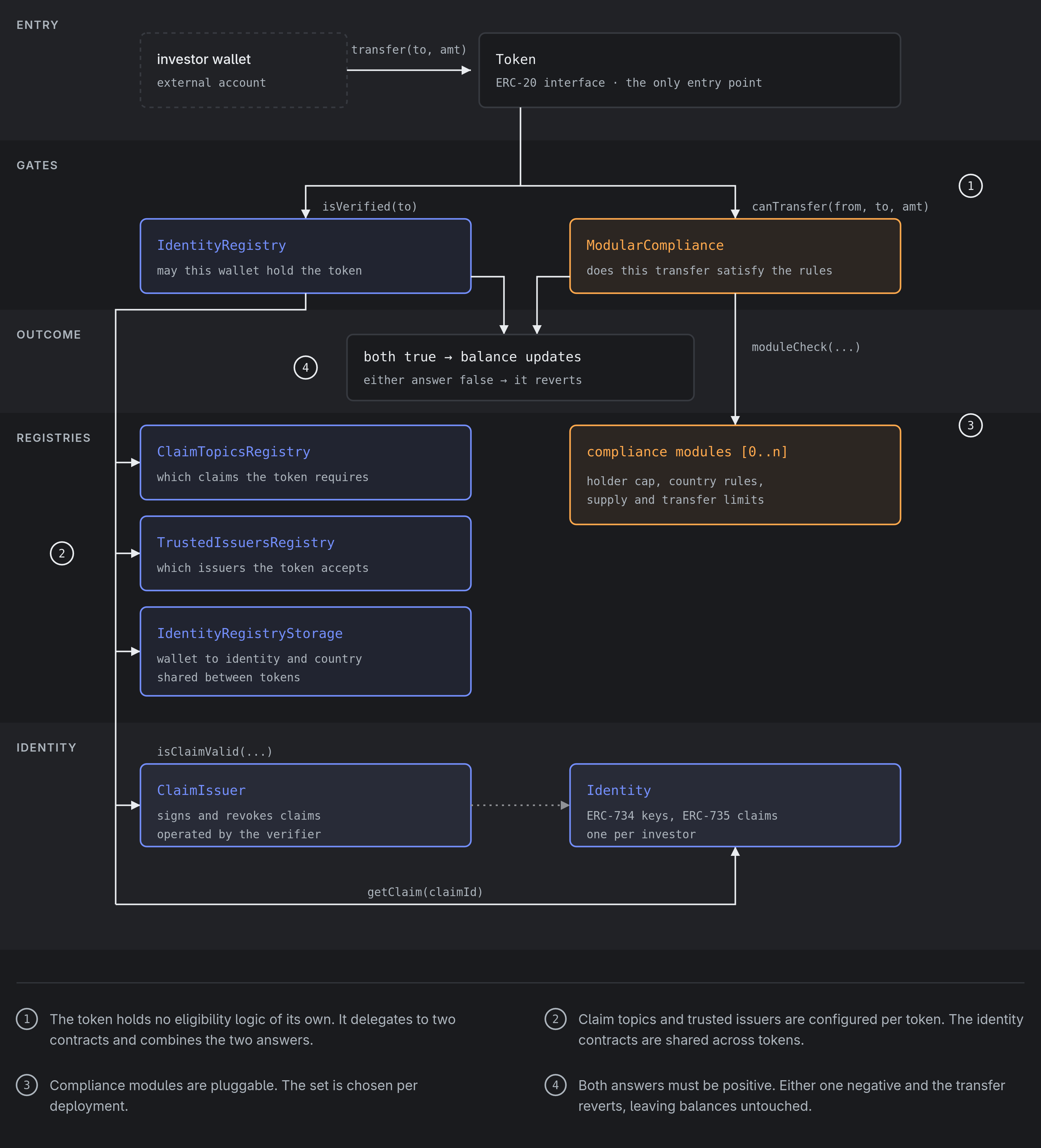
The T-REX architecture is modular, splitting responsibilities across several interacting contracts rather than hard-coding compliance logic into the token itself.[2]
The token contract is the only address an investor ever interacts with, and it holds no eligibility logic of its own. When a transfer is called, the token puts two independent questions to two different contracts and combines the answers: may this wallet hold the token?, which the Identity Registry answers, and does this transfer satisfy the token’s rules?, which the Compliance contract answers. The balance updates only if both come back positive.
Neither answer is a stored flag. The Identity Registry composes its answer from three sources — a Claim Topics Registry listing which claims this token requires, a Trusted Issuers Registry listing which issuers it accepts for each of those topics, and an Identity Registry Storage holding the wallet-to-identity mapping and the investor’s country. With those in hand it reads the relevant claim from the investor’s own identity contract and asks the issuing party to confirm the signature still stands.
The Compliance contract works the same way one level down. It holds no rules itself, only a list of bound modules, and a transfer passes when every one of them approves. Holder caps, country restrictions, supply ceilings and transfer limits are each a separate module, and the set is chosen per deployment rather than fixed by the standard.
The distinction worth carrying into the sections below is which parts belong to the token and which do not. The registries and the compliance modules are configured per token, each issuer decides what to require and whom to trust. The identity contracts are not: an investor’s ONCHAINID, and the claim issuers who sign for it, sit outside any single deployment and are reused across every token that recognizes the same issuers. That separation is what makes ERC-3643 more than a permissioned allowlist.
The token contract layers additional controls on top of standard ERC-20 behavior. transfer() and transferFrom() calls first pass through the Identity Registry and Compliance Contract before any balance changes occur. Beyond transfers, the contract typically exposes agent-restricted functions for minting to verified investors only, burning, freezing specific addresses or token amounts, executing forced transfers under defined governance conditions, and recovering tokens tied to a lost wallet by reassigning them to a newly verified address for the same identity. These administrative functions are usually gated behind agent or owner roles, which is precisely why key management around them is a first-order security concern (discussed below).[1][2]
The identity check runs on the recipient only. transfer(), transferFrom(), mint(), and forcedTransfer() all call isVerified() on the destination address, never on the sender. Because every path that moves tokens into a wallet checks that wallet first, a holder is by construction someone who passed verification at the time they received. Their eligibility is not re-checked on the way out. An investor whose KYC claim is revoked can still send their entire balance to any other verified holder, and stopping them is a separate, deliberate act: an agent has to freeze the address.
The Identity Registry is the component that maps a wallet address to a verified on-chain identity and confirms that identity carries the claims required for that specific token. Conceptually, the chain runs: wallet → identity contract → verified claims → token eligibility. The registry supports registering new investors, updating or removing wallet-identity links, and performing the verification check invoked automatically during a transfer attempt.[5][1]
ONCHAINID is the identity layer that ERC-3643 relies on, and it deserves more than a passing definition because it is where most of the standard’s compliance logic actually lives. Each investor deploys a personal identity smart contract, built on two supporting standards: ERC-734 for key management and ERC-735 for claims management. The identity contract is not tied to any single token — an investor deploys it once and can reuse the same identity across every ERC-3643 compatible platform that recognizes ONCHAINID.[6][7][8][5]
ERC-734 governs the keys attached to an identity — cryptographic keys with defined purposes such as management, action execution, or claim signing. ERC-735 governs claims — attestations issued by a trusted third party about the identity holder, referenced on-chain by a hash that points to encrypted, off-chain evidence.[9][8][6]
The complete lifecycle of an identity claim runs as follows:
An ERC-735 claim record has six fields: topic, signature scheme, issuer, signature, data, and a URI. There is no validity period. When the Identity Registry checks a claim, it verifies exactly two things: that the signature recovers to a key the issuer has designated for signing claims, and that the signature has not been revoked. No date is compared, because there is no date to compare. A KYC claim signed three years ago remains cryptographically valid and will keep passing eligibility checks until someone revokes it. Time-bounded eligibility has to be built on top, either as an off-chain process that watches for lapsed verification and calls the issuer’s revocation function, or as a compliance module that enforces its own freshness rule.
This lifecycle is what allows a single identity to be reused: once an investor is KYC-verified by a trusted issuer, that claim can support eligibility checks across every ERC-3643 token that recognizes the same issuer and claim topic, rather than requiring the investor to reverify per platform.[7]
The Trusted Issuers Registry defines which entities a token issuer recognizes as authoritative for specific claim topics. A single token deployment can register multiple trusted issuers — for example, a European KYC provider authorized to issue identity and residency claims, and a separate US-based provider authorized to issue accreditation claims under Reg D. When an investor from either region attempts a transfer, the Identity Registry checks whether the claim on their identity was signed by an issuer the token trusts for that specific topic. This structure is what allows a single ERC-3643 token to serve a genuinely cross-border investor base without hard-coding a single verification provider into the contract.
Claim topics define the categories of eligibility a token requires — for example, KYC completion, accredited investor status, jurisdiction of residence, or investor category (retail vs. institutional). The Claim Topics Registry translates business and legal requirements into machine-verifiable conditions: rather than an issuer manually checking a spreadsheet, the token contract checks whether an investor’s identity holds a valid, correctly signed claim for each required topic before allowing a transfer.[2]
The Compliance contract holds no rules of its own. It keeps a list of bound modules and asks each one in turn whether a transfer may proceed, and the transfer passes only if every module approves. The rules that apply to the token as a whole live in those modules: a maximum number of holders, a balance cap per investor, country allow or restrict lists, a supply ceiling, time-based transfer limits. A simplified illustration of how the token and the Compliance contract divide the work (pseudocode, not deployable Solidity):[2]
// on the token, before any balance changes
function transfer(to, amount) {
    require(identityRegistry.isVerified(to));
    require(compliance.canTransfer(msg.sender, to, amount));
    ... update balances
}

// on the compliance contract
function canTransfer(from, to, amount) returns (bool) {
    for (module in boundModules) {
        if (!module.moduleCheck(from, to, amount)) return false;
    }
    return true;
}
Because the check is a loop over the bound list, a Compliance contract with no modules bound approves every transfer. The rule set is a deployment decision rather than something the standard supplies, which is why a review of an ERC-3643 deployment has to cover the module configuration and not only the contracts. Each module is a separate deployed contract bound to the Compliance contract rather than code inside it, and the exact interfaces should be verified against the current official ERC-3643 repository before implementation.[2]
Consider Alice attempting to transfer 100 tokens representing a regulated real-world asset to Bob.
transfer(bob, 100) on the token contract.In production the failures that come up most often are the state checks at step 2 and the identity check at step 4: a frozen wallet, a balance that is partially frozen, or a recipient who was never registered. The identity check and the compliance check share a single revert reason, so a rejected transfer does not say which of the two turned it down. The compliance layer sits in front of, not instead of, the underlying token logic.
A realistic ERC-3643 deployment does not start with the token contract, and it does not start with the investors either. Using the reference factory, most of the suite is created in a single transaction:
On the tooling front, OpenZeppelin has partnered with T-REX Network as a strategic technical partner to co-design the next phase of the T-REX Protocol and deliver ERC-3643 as an audited component within the OpenZeppelin Contracts library, aiming to let developers import it the same way they import ERC-20 or ERC-721 today. This work also covers evolution of ONCHAINID, including a cross-chain identity model, and extending support to non-EVM chains. As of this writing, that library integration is part of an active partnership announced in July 2026 — treat specific release timelines as a roadmap item to verify against current OpenZeppelin documentation rather than an already-shipped feature.[10][11]
Solidity implementations of ERC-3643 build directly on EVM-compatible deployment patterns familiar from standard smart contract development, with the added complexity of registry cross-contract calls on every transfer.
Every contract in a T-REX suite is a proxy. The token, the Identity Registry, the Identity Registry Storage, the Trusted Issuers Registry, the Claim Topics Registry and the Compliance contract each hold their own storage but read their executable logic from a single implementation authority. Upgrading the token means changing one address on that authority, and the change takes effect for every suite deployed against it at once.
That is the standard’s strongest operational feature and its sharpest concentration of power, in the same sentence. A bug in the token logic can be fixed everywhere without migrating balances or asking holders to do anything. The same call, made with the same key, can also change what a token does. Whoever controls the implementation authority controls the behaviour of every token pointing at it, which is why an issuer running a serious deployment usually runs its own authority rather than sharing one.
Ownership of the suite is a separate matter, and more granular than it first appears. Five contracts each have their own owner, and each owner can change something the transfer path depends on: the token owner can repoint the token at a different registry or compliance contract, the Identity Registry owner can swap out the registries it consults, and the Claim Topics, Trusted Issuers and Compliance owners each control the contents of their own list. The reference factory assigns all five to the same address at deployment. Separating them afterwards, or putting them behind a multisig, is a decision the issuer makes rather than one the standard makes for them.
One contract is built to outlive any single token. The Identity Registry Storage holds the wallet-to-identity mapping, and more than one Identity Registry can bind to the same storage, which is how an issuer with several tokens lets an investor be registered once instead of once per asset. It is also the one contract the factory does not hand over at deployment.
Beneath ownership sits the agent role, granted per contract and independent of it. Agents do the day-to-day work: minting to verified investors, registering identities, freezing wallets or parts of a balance, pausing the token. Two agent functions reach further than the rest. A forced transfer moves tokens out of a holder’s wallet without their consent, and recovery reassigns an entire balance to a replacement wallet. Both exist because regulated assets genuinely need them, and both are why agent keys deserve the same protection as ownership keys.
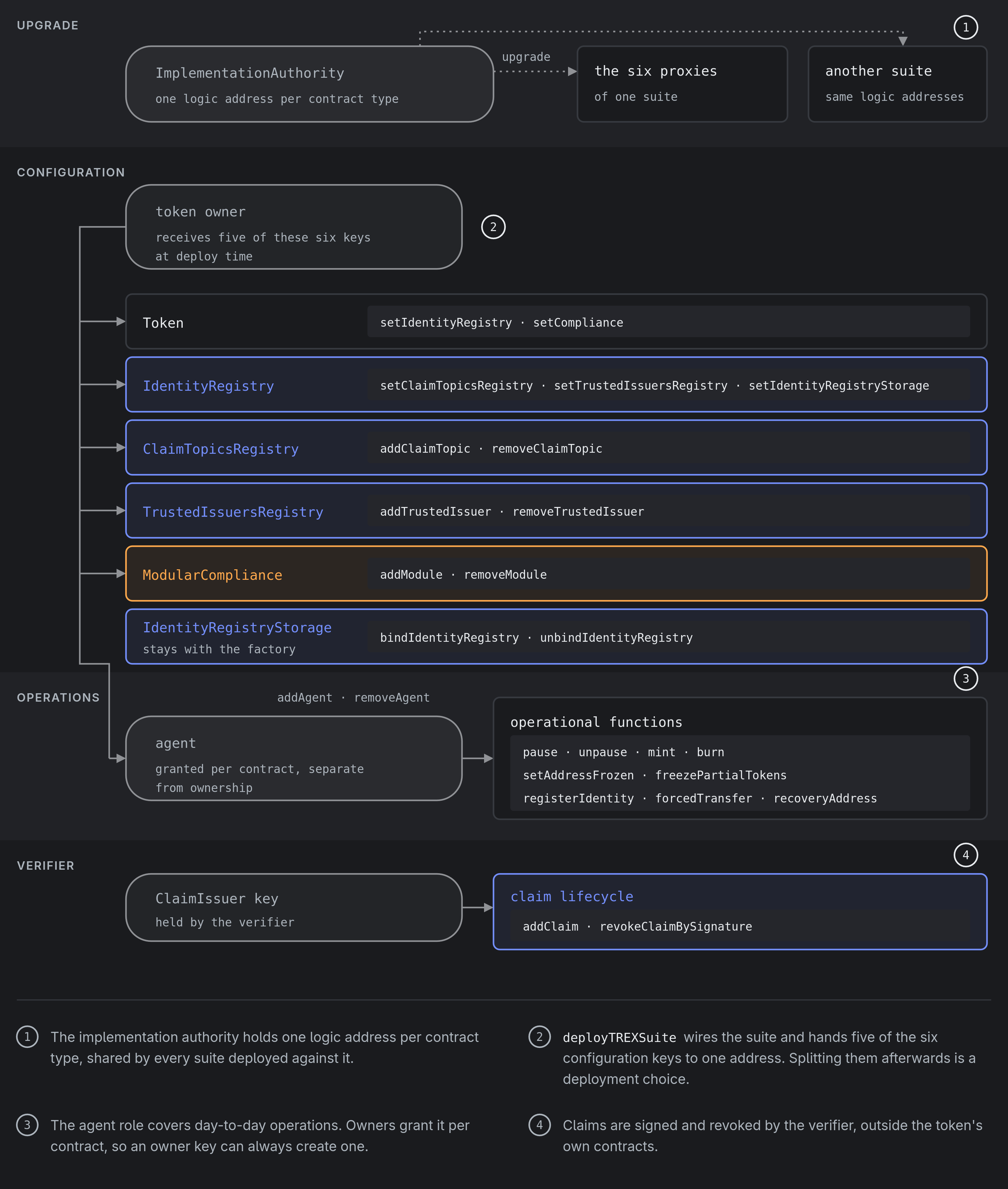
The identity layer answers to none of these. Claims are signed and revoked by the verifier, using the verifier’s own key, on the verifier’s own contract. An issuer chooses which verifiers to trust, but cannot issue a claim on their behalf or withdraw one they have issued.
Security review for ERC-3643 deployments has to go beyond a generic “audit the contract” checklist, because much of the risk surface sits in privileges and configuration rather than in a single function.
Given the concentration of privilege in agent and admin roles, teams building or migrating an ERC-3643 deployment typically benefit from an independent security review of the registry configuration and access control model before mainnet launch, alongside standard ERC-20 security practices. On the monitoring side, robust on-chain data extraction and blockchain forensics infrastructure support the audit trails that regulated issuers need for AML oversight.
One of ERC-3643’s more distinctive capabilities is supporting a single token deployment across investors subject to different regulatory regimes, by combining Claim Topics, multiple Trusted Issuers, jurisdiction-tagged identity claims, and Compliance Module rules.
Consider an issuer targeting investors in the European Union, the United States, and Singapore. Under this design, EU investors could hold claims relevant to obligations frequently discussed under the EU’s Markets in Crypto-Assets framework, US investors could hold claims corresponding to exemptions such as Regulation D or Regulation S, and Singapore-based investors could hold claims aligned with Monetary Authority of Singapore requirements. The Trusted Issuers Registry would recognize different verification providers for each region, and the Compliance Contract could apply jurisdiction-specific limits — for instance, capping US-eligible holders under an exemption threshold while allowing broader EU participation.
It is important to be precise here: this describes how rules can be encoded into token infrastructure, not a claim that a given smart contract configuration makes an issuer legally compliant in any of these jurisdictions. MiCA does not automatically govern every tokenized security, and no single technical configuration substitutes for jurisdiction-specific legal analysis. Whether a given regulatory framework applies, and what obligations follow, depends on the specific asset, its legal classification, and the issuer’s operating jurisdiction — a determination that requires legal counsel, not smart contract architecture alone.
ERC-3643’s ERC-20 base compatibility means it can technically interact with contracts expecting standard ERC-20 interfaces, but that compatibility does not resolve the underlying tension between permissioned ownership and permissionless DeFi.
The practical friction shows up wherever a smart contract, rather than a human wallet, needs to hold the token. A decentralized exchange’s liquidity pool, an AMM contract, a lending protocol’s collateral vault, or an LP token wrapper are themselves addresses — and under ERC-3643’s design, any address receiving tokens must satisfy identity eligibility checks. A pool contract typically has no ONCHAINID identity and cannot pass a KYC claim check, so a naive integration attempt fails at the transfer stage. This is the core limitation developers need to solve, not a footnote: composability requires either exempting specific protocol-owned addresses through the Compliance Module (with careful governance over which contracts qualify), building wrapped or synthetic representations that separate compliant custody from a tradable derivative, or restricting DeFi interaction to permissioned venues where every participant is independently verified.
None of these approaches is a drop-in replacement for permissionless DeFi composability; each introduces new governance and audit surface. Teams evaluating this path should treat identity-aware DeFi integration as a distinct architecture decision — an area where 4soft’s DeFi development experience, including work on collateral and lending integrations, is directly relevant to structuring compliant-asset connectivity without silently reintroducing permissionless risk.
The clearest public signal of scale in the July 2026 OpenZeppelin and T-REX Network announcements is a forward commitment rather than a current total: Apex Group has committed to adopting the T-REX Ledger as its default infrastructure, targeting $100 billion in tokenized assets by June 2027. The standard is governed and promoted by the ERC3643 Association, and Tokeny is a recognized reference implementer and documentation provider for the T-REX protocol.[11][3][7]
Adoption figures and named-adopter lists in this space change quickly; readers evaluating current scale should check the ERC3643 Association’s official announcements and OpenZeppelin’s documentation directly rather than relying on older secondary sources.
In July 2026, OpenZeppelin and T-REX Network announced a strategic technical partnership to co-design the next phase of the T-REX Protocol, covering protocol architecture, ONCHAINID’s evolution (including a cross-chain identity model), security hardening, and delivery of ERC-3643 as an audited component of the OpenZeppelin Contracts library. The stated goal is to let any EVM developer import ERC-3643 the way they currently import ERC-20 or ERC-721 contracts, while also extending support to non-EVM blockchains.[10][11]
For developer adoption, this matters because audited, library-grade contract components lower the barrier to correct implementation and reduce the risk of custom, unaudited compliance logic. For security, an OpenZeppelin-hardened implementation benefits from the same review rigor applied to its widely used ERC-20 and ERC-721 libraries. It’s worth distinguishing what is confirmed now — the partnership itself, its stated scope, and EIP-3643’s Final status — from roadmap items such as full non-EVM support and the finished cross-chain identity model, which were described as active workstreams rather than completed deliverables at the time of the announcement.[3][11][10]
A structured way to evaluate the standard for a specific project:
ERC-3643 transfers carry measurable additional gas overhead compared to a plain ERC-20 transfer, because each transfer triggers external calls to the Identity Registry (to resolve the recipient’s identity and check claim validity against the Claim Topics Registry) and to the Compliance Contract (to evaluate token-level rules such as holder caps or ownership limits) before the underlying balance state is updated. How much overhead depends on how the token is configured, so the only useful answer is a measured one.[1][2]
The overhead is not spread evenly, and where it sits is the useful part. Most of it goes to claim verification rather than to compliance rules: each required claim topic means a lookup in the Trusted Issuers Registry, a read from the investor’s identity contract, and a signature recovery plus revocation check on the issuer’s own contract. A compliance module, by comparison, is a single call into a contract that already holds its state, and costs a fraction of that. The claim topic list is the more significant lever on transfer cost, which is the opposite of where most teams look first.
What the cost does not scale with is the size of the deployment. A transfer costs the same whether the token has ten holders or ten thousand, and the same whether it moves a single unit or the entire supply. It is a function of how the token is configured, decided once, rather than of how much the token is used. Absolute figures depend on the contract version, the compiler and optimizer settings, and how much external state each module reads, so any number quoted for “an ERC-3643 transfer” describes one configuration rather than the standard.
ERC-3643’s defining characteristic is not that it tokenizes an asset — any ERC-20 contract can do that — but that it connects every token transfer to identity verification and programmable compliance rules enforced at the smart contract level. That distinction is what makes the erc3643 token standard the appropriate infrastructure for regulated securities, tokenized funds, and other RWAs where investor eligibility cannot be an afterthought, while a plain ERC-20 or an ERC-1400 implementation may remain the better fit for less restricted token designs.[1][2]
Correctly implementing this architecture — registries, claim issuers, compliance modules, agent roles, and their interactions with identity contracts — carries real security and governance stakes, from privileged key management to correct compliance rule configuration. 4soft works with fintech and blockchain teams on smart contract development, Solidity security audits, tokenization system architecture, and DeFi integration design, including the kind of identity-aware compliance logic ERC-3643 requires. If your team is scoping an RWA tokenization project or reviewing an existing ERC-3643 deployment, a structured architecture and security review before mainnet launch is worth the conversation.

