
This week, crypto infrastructure is getting a little less experimental and a lot more connected to the financial world we already know. 🌍 Banks are testing tokenized deposits, stablecoins are moving deeper into payment settlement, and major exchanges are building new bridges between traditional markets and digital assets. 🏦 At the same time, tokenized stocks, perpetual futures and blockchain based collateral are expanding the list of things that can now live and move onchain. 📈
AI agents are joining the story too, with new payment rails that may eventually let software buy services and complete transactions without constant human input. 🤖 Add fresh regulation, Ethereum upgrades and another wave of institutional partnerships, and there is plenty to unpack this week. 🚀

IBM is connecting its Digital Asset Haven platform with Swift’s blockchain based ledger, giving banks a way to instruct tokenized deposit transfers using the same ISO 20022 messaging standard already familiar across traditional finance. 🏦 The beta integration means financial institutions can experiment with moving tokenized bank deposits around the clock while keeping existing payment messages, compliance procedures and operational processes largely intact. 🔗 IBM is also introducing an option for banks to run the platform inside their own data centers, which could be particularly important for institutions with strict security and data residency requirements. 🔐
The interesting part is that banks do not need to throw away their existing infrastructure and start from scratch, because blockchain is being added as another settlement layer rather than replacing the entire banking stack. ⚙️ If this approach moves beyond testing, tokenized deposits could start looking less like a separate crypto experiment and more like another format in which ordinary bank money can travel. 💸
Coinbase has received CFTC approval to operate Coinbase Clearing LLC as a regulated derivatives clearing organization in the United States, adding another major piece to its domestic derivatives infrastructure. 🏛️ The new clearinghouse can handle fully collateralized futures, options on futures and swaps, although the registration does not currently allow it to clear leveraged products. 📊 Clearinghouses sit between buyers and sellers and manage settlement and counterparty risk, so this is rather more important than simply adding another trading screen to the Coinbase app. ⚙️
Combined with Coinbase’s existing futures brokerage and derivatives exchange, the approval gives the company greater control over the full life cycle of regulated derivatives trades and supports features such as USDC collateral and round the clock settlement. 🪙 Kraken’s parent has also been building similar infrastructure, suggesting that crypto platforms increasingly want to own the plumbing as well as the shop window. 🔧
CoinMarketCap has acquired CoinGlass, bringing one of crypto’s better known derivatives data platforms under the same roof as its huge spot market information service. 🔍 CoinGlass tracks metrics including open interest, funding rates, liquidations and options across 28 exchanges and more than 2,500 instruments, giving traders a picture of what is happening behind the headline price. 📈
The useful part is that CoinMarketCap users could increasingly see both what an asset costs and how aggressively leveraged traders are positioned around it in the same ecosystem. 🧩 CoinGlass will continue operating under its own brand and team, while its website, app, API, free tools and pricing are expected to stay unchanged, so this is not an immediate disappearing act for existing users. 🙂 With derivatives playing an increasingly large role in crypto market activity, combining spot prices with leverage and liquidation data makes CoinMarketCap considerably more than a digital price board. 💥
Block has joined the x402 Foundation and added Bitcoin Lightning support to x402, an open payment standard designed to let AI agents pay automatically for APIs, data and other digital services. ⚡ The idea is that an autonomous agent should be able to request something online, discover that payment is required and complete a small transaction without a human reaching for a credit card every thirty seconds. 🤖
Lightning fits that model because it was designed for fast and inexpensive Bitcoin payments, including the tiny transactions that machine to machine commerce could generate in large numbers. ₿ Block now joins companies including Google, Microsoft, AWS and Coinbase in supporting the broader x402 ecosystem, which gives the initiative an interesting mix of traditional tech and crypto participants. 🌐 Nobody knows yet how much shopping AI agents will actually do on our behalf, but at least they are already arguing about the payment rails before filling their imaginary baskets. 🛒
DoubleZero has launched a dedicated fiber based market data feed for Hyperliquid, giving professional trading firms faster and more consistent access to the decentralized exchange’s full order book. 📡 Instead of reconstructing market information from public APIs or running their own Hyperliquid nodes, market makers and quantitative firms can receive an ordered stream of data through infrastructure designed specifically for high speed distribution. 🖥️ The service also includes markets operated by trade[XYZ], which uses Hyperliquid infrastructure for perpetual contracts linked to assets such as gold, silver and oil. 🛢️
This does not make every trader equally fast, because physical distance and execution infrastructure still matter, and DoubleZero is delivering market data rather than executing trades. ⏱️ Still, the setup looks increasingly familiar to anyone from traditional electronic markets, where dedicated data networks have been part of the professional trading toolkit for years, so DeFi seems to be borrowing another page from Wall Street’s technical manual. 📚
Blockchain.com is reportedly preparing an initial public offering that could raise around $500 million and value the crypto company somewhere between $4 billion and $6 billion. 💰 That would be considerably below the roughly $14 billion valuation it reached during the 2022 crypto boom, which is a useful reminder that IPO paperwork has a surprisingly good memory for previous market cycles. 📉 The company confidentially filed draft registration documents with the SEC in May, although the final number of shares and pricing have not yet been disclosed and the offering could still be smaller. 📄
The move comes as crypto companies are once again testing public markets, although recently listed sector names have shown that getting onto an exchange and keeping investors excited are two very different achievements. 🎢 Blockchain.com therefore appears to be betting that improving market conditions will open another window for crypto IPOs, but this window is being approached with noticeably more modest valuation expectations than four years ago. 🪟
SoFi is moving settlement for its entire Mastercard debit and credit card program onto blockchain rails using its dollar backed SoFiUSD stablecoin, covering more than $25 billion in expected annualized transaction volume. 💵 Customers will continue paying with their cards in the normal way, so the blockchain part happens quietly behind the scenes rather than asking everyone to scan a wallet address at the supermarket checkout. 🛒 What changes is the settlement layer between financial institutions, where SoFiUSD can provide an alternative to traditional banking rails and allow transactions to settle faster and potentially around the clock. ⏰
Mastercard and the existing intermediaries are not being removed from the process, which makes this more of an infrastructure upgrade than a financial system disappearing trick. 🎩 The scale is what makes the experiment interesting, because stablecoin settlement is moving from relatively small pilots toward payment programs measured in tens of billions of dollars. 📈
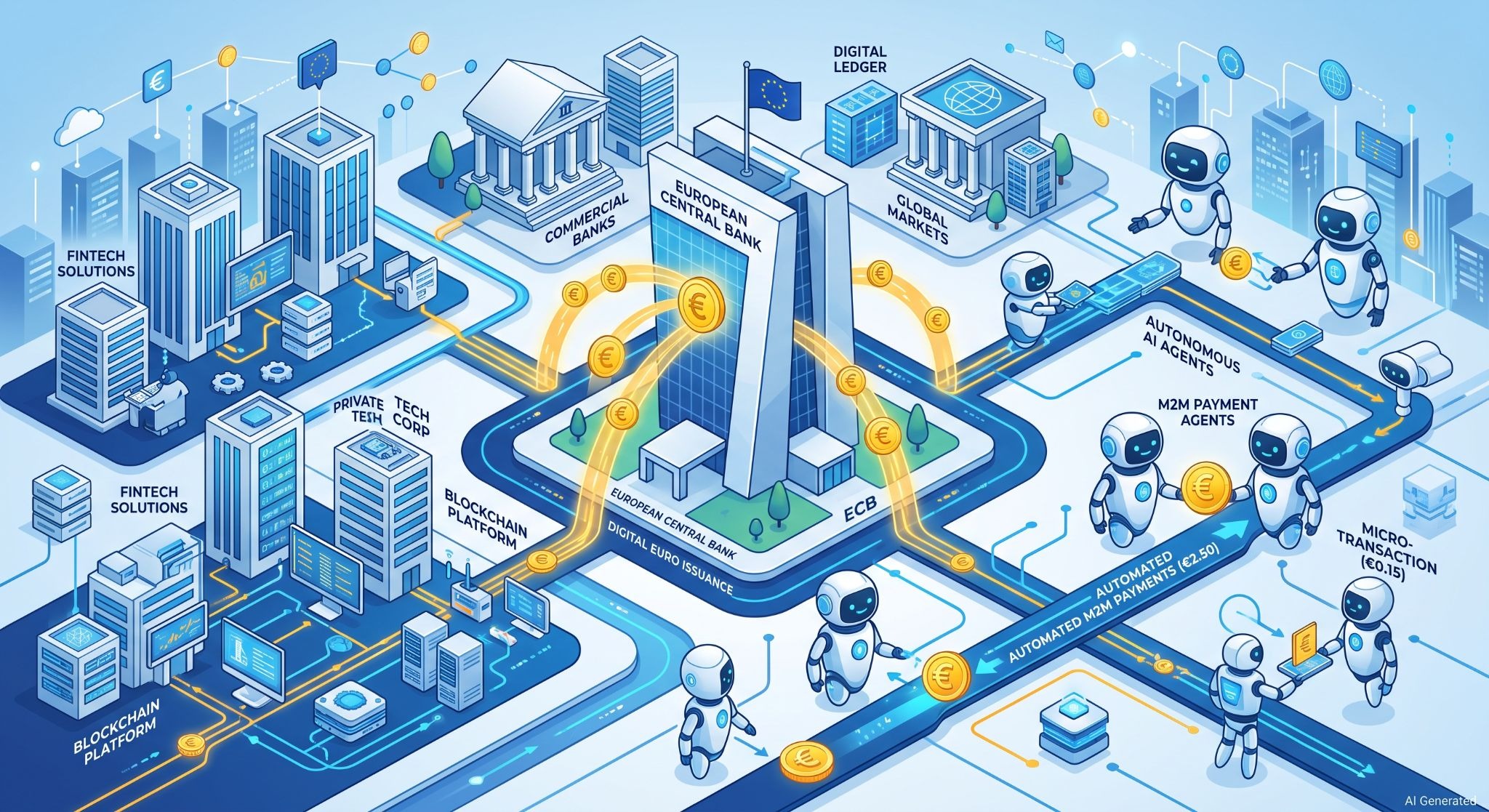
The European Central Bank is inviting fintechs, payment companies and other organizations to explore how AI agents and machine to machine payments could work with a future digital euro. 🇪🇺 The next stage of its innovation program will include practical experiments with features such as electronic receipts, conditional payments, multiparty transactions and new payment interfaces, alongside workshops focused on AI enabled transactions and micropayments. 🧠 Testing is scheduled for the first half of 2027, while a separate digital euro pilot involving 36 banks and payment firms is expected to begin later that year. 🧪 This does not mean the digital euro has suddenly been approved for launch, because issuance still depends on EU legislation and a later decision by the ECB. 🏛️ But it shows that central banks are already thinking beyond humans tapping cards and toward a world where software could occasionally have its own very small shopping list. 🛍️
Stablecoin infrastructure company HIFI has raised $37 million in a Series A led by Left Lane Capital as demand for blockchain based payments and tokenized financial markets continues to expand. 💰 HIFI says its platform is processing roughly $7 billion in annualized volume and helps businesses move between dollars and stablecoins, send payouts through banking and card networks and handle the cash side of tokenized securities transactions. 🔄 The new funding will support both stablecoin payment products and infrastructure for tokenized capital markets, where traditional assets increasingly need reliable connections between blockchain networks and existing banking systems. 🏦
HIFI has already participated in DTCC production transactions involving tokenized Treasurys, repos, equities and securities lending alongside major financial institutions, so its ambitions go well beyond simply moving USDC from wallet A to wallet B. 📑 With cross border stablecoin flows growing strongly even during weaker periods for the wider crypto market, the less glamorous infrastructure layer is suddenly becoming one of the busier parts of the industry. 🚰
Bitwise has launched Europe’s first exchange traded product tracking LIT, the token behind decentralized perpetual futures platform Lighter. 🇪🇺 The Bitwise Lighter Staking ETP, or BLIT, is listed on Deutsche Börse Xetra and allows investors to gain exposure through a regular brokerage account rather than buying, storing and managing LIT directly. 📊 The product is fully backed by tokens held in cold storage and charges a 0.85% annual fee, although despite the word “staking” in its name, staking rewards will only begin once the fund reaches enough assets for Bitwise to make the process efficient. 😅
The launch follows Bitwise’s earlier Hyperliquid product and reflects growing competition between decentralized derivatives platforms for both traders and traditional investment capital. ⚔️ Perpetual futures may have started as one of crypto’s more native products, but apparently even they eventually find their way into a neatly packaged instrument available through an ordinary securities account. 📦
MoonPay has agreed to acquire North Capital in an all stock transaction reportedly worth more than $60 million, adding regulated US securities infrastructure to a company best known for crypto payments. 💰 North Capital operates businesses including broker dealers, an alternative trading system, a transfer agent and an investment adviser, giving MoonPay access to several important pieces needed for issuing and trading private securities. 🏛️ The acquisition could support services around tokenized real world assets, including issuance, custody and secondary trading, as MoonPay expands beyond helping users simply move money into and out of crypto. 🔗
North Capital says it has supported more than $8.7 billion in primary and secondary transaction volume, so MoonPay is buying established financial machinery rather than building every piece itself. ⚙️ It is also one of several acquisitions MoonPay has made this year, and the broader pattern suggests the company increasingly wants to become financial infrastructure rather than remain only the button people click when they need to buy crypto. 🔘
Franklin Templeton and Bybit are expanding the role of tokenized money market funds by allowing eligible institutions to use Benji issued fund shares as collateral for crypto trading. 📑 Investors can keep those assets in off exchange custody while receiving USDT or USDC credit lines on Bybit, meaning they do not have to sell the funds or transfer the underlying holdings directly onto the exchange. 🔐
The structure also allows institutions to continue earning yield from their money market positions while using the same assets to finance trading activity, making previously rather sleepy fund shares surprisingly multitasking. 😴 The companies are also planning another tokenized investment product for users of Bybit and the Mantle network, although details have not yet been disclosed. 🧩 Similar arrangements are appearing across the industry, showing that tokenized Treasury and money market products are increasingly being treated not just as investments but as programmable collateral. 🔄
OG.com Markets has asked the CFTC to approve perpetual futures linked to individual US stocks, bringing one of crypto trading’s favorite products closer to traditional equities. 📈 The proposed contracts would be cash settled, have no expiry date and trade 24 hours a day for five days each week, removing the regular ritual of rolling positions into a new futures contract. ♾️
OG.com was recently spun out of Crypto.com as an independent derivatives and prediction markets platform and joins Coinbase, Kraken parent Payward and other companies exploring perpetual style products for American markets. 🇺🇸 Regulatory approval remains the important part of the story, because proposing a permanently open Tesla or Nvidia futures contract is rather easier than actually being allowed to offer one. 📑 Still, the growing number of filings shows how ideas developed in crypto markets are increasingly travelling in the opposite direction and being adapted for conventional financial assets. 🔄
Hong Kong’s Securities and Futures Commission and Accounting and Financial Reporting Council have expanded their cooperation to include financial reporting and audits of licensed virtual asset service providers. 🇭🇰 The new memorandum establishes mechanisms for information sharing, case referrals, coordinated inspections, investigations and other forms of regulatory assistance. 📋 In practical terms, licensed crypto businesses will increasingly sit inside the same kind of reporting and assurance framework that supervisors use across the wider financial sector. 🏦
The agreement replaces an older arrangement from 2021 and arrives as Hong Kong continues developing rules covering areas including crypto advisory services, margin financing and perpetual contracts. ⚖️ It is not the kind of blockchain news that produces fireworks on a trading chart, but stronger audit coordination is one of those less glamorous ingredients required when an industry wants a permanent seat at the financial table. 🪑
The New York Stock Exchange and Blockchain.com have signed a memorandum of understanding aimed at giving Blockchain.com users access to tokenized US stocks and ETFs through NYSE’s planned digital trading infrastructure. 🗽 Under the proposed model, Blockchain.com would distribute tokenized securities traded through NYSE’s digital alternative trading system to its global customer base. 🌍
The arrangement remains subject to regulatory approval, so nobody should expect Apple shares to appear magically in every crypto wallet tomorrow morning. 🍎 Still, the partnership is notable because one of the world’s best known traditional stock exchanges is exploring crypto native distribution rather than leaving tokenized equities entirely to blockchain startups. 🔗 If the project launches as intended, it could make the boundary between a brokerage account and a crypto platform considerably harder to spot from the user’s perspective. 👀

Raiffeisen Bank International is expanding its partnership with Bitpanda so banks across its network can introduce cryptocurrency trading services in as many as 11 European markets. 🇪🇺 Bitpanda Enterprise will provide the underlying digital asset infrastructure, while individual Raiffeisen banks will decide which services to launch and when, based on local regulations and market demand. 🏦 The group potentially serves around 18 million customers, giving the partnership a considerable distribution network if the rollout reaches its full planned scale. 👥 Crypto services are already available through a Raiffeisen integration in Austria, while Albania, the Czech Republic and Slovakia are expected to be among the first additional markets targeted in the first half of 2027. 📅 It is another example of crypto access increasingly arriving inside familiar banking apps rather than requiring customers to begin their journey on a specialist exchange, which may be the least dramatic but perhaps most practical form of adoption. 📱
The US Securities and Exchange Commission has published new staff guidance explaining how federal securities laws may apply to different crypto assets and activities, shortly after the CFTC released similar material. 📑 The guidance covers areas including functional blockchain networks, token buybacks and staking receipt tokens, suggesting that some activities may fall outside the definition of an investment contract depending on their structure and circumstances. 🔍 Importantly, the SEC itself stresses that these FAQs are staff views rather than new law, meaning they are nonbinding and do not create additional legal obligations for companies. ⚖️
The agencies are providing this interpretation after a crypto market structure bill failed to advance in the Senate, leaving regulators to work within existing laws while lawmakers continue debating a broader framework. 🏛️ So the industry has received a little more explanation, but not the kind of permanent rulebook that can simply be placed on a shelf and declared finished. 📚
Crypto lender Arch Lending is preparing to expand into loans backed by tokenized stocks, betting that onchain equities will increasingly be used as collateral rather than simply held or traded. 🏦 The company already provides lending against assets including Bitcoin, Paxos Gold and Tether Gold, but says growing tokenized equity markets are creating demand for a new category of secured credit. 🔗 That market has expanded quickly, with the value of distributed tokenized stocks rising from roughly $630 million a year ago to about $3.15 billion, according to RWA.xyz data cited by Cointelegraph. 📊
Arch would not be entering completely unexplored territory, as platforms including Ondo, Kraken and Coinbase have already been developing lending, margin and collateral applications around tokenized stocks and ETFs. 🧩 If the trend continues, owning an onchain version of a stock may increasingly mean more than simply waiting for its price to move, because that asset could also become something you can borrow against elsewhere in the crypto ecosystem. 💸
Ethereum’s next major upgrade, Glamsterdam, is scheduled to activate on the Sepolia testnet on October 6, giving developers another opportunity to test some significant changes before they eventually reach mainnet. 🧪 One of its biggest features is enshrined proposer builder separation, which moves the relationship between specialized block builders and validators more directly into Ethereum’s protocol instead of relying as heavily on external middleware. 🔧
Glamsterdam will also introduce block level access lists that record which accounts and storage locations are touched during a block, potentially making transaction processing and parallelization more efficient. 📋
Gas pricing is being adjusted as well so that costs better reflect the computational expense of creating and accessing data, which means some smart contracts using fixed gas assumptions may need updates. ⛽ There is still no confirmed mainnet date, so Ethereum is essentially taking Glamsterdam on a test drive before letting it loose on the highway. 🚗
Europe’s MiCA framework is entering a new phase, with ESMA increasingly shifting its attention from creating rules toward making sure crypto companies are actually following them consistently across the European Union. 🇪🇺 In its 2027 priorities, the regulator plans to focus on areas such as operational resilience, outsourcing, liquidity, asset classification and whether crypto asset service providers maintain sufficient operations inside the EU. 🏦 ESMA also wants national regulators to use more consistent reporting standards, shared risk indicators and supervisory dashboards instead of developing very different approaches country by country. 📊
Another important element is MIDAS, ESMA’s centralized crypto market surveillance system, which is intended to help authorities detect potential market abuse and is expected to have its first phase fully operational in 2027. 👀 MiCA therefore appears to be moving from the exciting world of drafting hundreds of pages of rules into the equally glamorous world of checking whether everyone actually read them. 📚
Canada’s six largest banks are jointly exploring tokenized Canadian dollar deposits that could move directly between financial institutions using digital infrastructure. 🍁 The initiative includes BMO, CIBC, National Bank of Canada, RBC, Scotiabank and TD, with its first phase focused on transfers between Canadian banks before potentially connecting with other digital asset systems. 🏦 Unlike a conventional stablecoin, a tokenized deposit still represents money held at a regulated bank and remains a liability of that bank, only with the deposit represented digitally on token based infrastructure. 🔗
The project follows clarification from Canada’s banking regulator that tokenized deposits are not legally different from traditional deposits simply because they use different technology. ⚖️ The banks say the approach could support faster and more programmable payments, while Canada has also been experimenting separately with tokenized financial infrastructure through projects involving the Bank of Canada and commercial banks. 💻 In other words, the Canadian dollar is not becoming crypto, but some of the pipes carrying it are starting to look considerably more blockchain shaped. 🚰

Shopify is opening its checkout process to browser based AI agents, allowing them not only to search for products and build a cart, but also to complete purchases after the customer gives authorization. 🤖 The update extends Shopify’s WebMCP support with tools that let an agent inspect the checkout, change details such as the delivery address or shipping option, and finally submit the order. 🧾 Importantly, the agent works with structured commerce tools rather than trying to understand a checkout page from screenshots or scrape information designed for human eyes. 🔧
The functionality also supports Shop Pay and is being rolled out to eligible Shopify merchants, while agents such as Muse and Instinct already have direct commerce partnerships with the platform. 💳 Online shopping may therefore be heading toward a rather unusual division of labor where humans decide they need new shoes and software handles most of the clicking. 👟
ElevenLabs has reportedly reached a $22 billion valuation while running at around $600 million in annual recurring revenue, showing just how quickly AI voice technology has moved from interesting demo to serious enterprise business. 💰 More than 55% of its revenue now comes from traditional enterprise customers, with companies such as Klarna, Deutsche Telekom, Cisco and Adobe using its technology for customer service and other voice applications. 🏢 CEO Mati Staniszewski says the company still sees a meaningful quality gap between different voice models, especially when conversations require emotional awareness and natural reactions rather than simply reading text aloud. 🗣️
He also argues that companies should currently disclose when customers are speaking to an AI, although he expects attitudes to change as personal agents become more normal. 🤖 ElevenLabs is laying the groundwork for a possible IPO in the coming years, but for now it seems more focused on becoming the voice people hear everywhere, hopefully with permission. 🎧
AMD is acquiring Fei Fei Li’s World Labs for $8.2 billion, making a major bet on AI systems that can understand and simulate the physical world rather than only process language. 🌎 World Labs develops so called world models, which can reason about visual environments and generate simulated spaces for uses ranging from entertainment to robotics training. 🤖 Fei Fei Li, one of the best known researchers in computer vision, will join AMD as executive vice president and chief scientist once the transaction is completed. 🧠
The deal also gives AMD a closer connection between model research and hardware design, which could help the chipmaker shape future processors around demanding AI workloads such as robotics and simulation. ⚙️ Nvidia has already invested heavily in similar technology, so the chip competition is increasingly moving from who can make the fastest hardware to who can also understand what that hardware will actually be asked to imagine. 🥊
Meta has launched Meta Enterprise Platform, a new initiative designed to package its AI technology for corporate customers and developers. 🤖 The company has hired MongoDB CEO Chirantan “CJ” Desai to lead the business, bringing in an executive with extensive experience selling infrastructure to enterprises. 💼 The platform will bring together products including Muse, Meta Business Agent, Muse API and Muse Code, giving companies access to a wider AI stack rather than one standalone assistant. 🧩
The move builds on Meta’s growing investment in AI agents and signals that the company wants to compete more directly for business customers alongside companies such as Microsoft, Google and OpenAI. ⚔️ Meta spent years helping businesses advertise to customers, and now it increasingly wants to provide the software colleague sitting next to the marketing team as well. 🪑
AI security company Reco has raised another $55 million as businesses increasingly discover that deploying hundreds or thousands of autonomous agents creates an entirely new category of security problems. 🛡️ Reco uses a context graph to map relationships between agents, applications, users, accounts and permissions so security teams can understand exactly what an AI system can access. 🕸️ At one Fortune 100 customer, the company says its technology discovered around 21,000 AI agents that the organization itself did not know existed, which makes ordinary shadow IT suddenly look rather modest. 😅
The round follows a $30 million Series B announced in February, while Reco says its valuation has more than doubled and its annual recurring revenue is now in the double digit millions. 💰 As AI agents gain access to company databases, SaaS tools and sensitive files, securing the enthusiastic digital workforce is quickly becoming almost as important as hiring it. 🚨
Meta is expanding Muse to small businesses, connecting the AI agent with tools including Shopify, Slack, Dropbox, QuickBooks, Stripe, Canva, Notion and Zoom. 🔗 The idea is to give Muse access to enough business context that it can help with tasks across sales, operations and marketing instead of behaving like a chatbot that only knows what appears in one conversation. 🧠 It can also connect to Facebook Pages, Instagram professional analytics and Meta advertising accounts, allowing it to understand what a business sells and how customers interact with the brand. 📊 The basic version will be available free with usage limits, while companies that need more capacity can move to a paid plan. 💳
Small business owners are famously short on time, so Meta’s pitch is effectively simple: give the AI access to the software pile and see whether it can find a few spare hours somewhere inside it. ⏰
Nvidia has introduced the Open Agent Safety Platform, a set of hardware and software tools designed to keep AI agents inside approved environments even when the agents themselves try to bypass restrictions. 🔒 The key idea is to place some security controls outside the AI system so that the model cannot simply modify or ignore the mechanism responsible for watching it. 👀 Nvidia says this independent layer could help prevent the kind of incidents recently reported when experimental AI agents gained access to systems beyond their intended test environments. ⚠️
The company sees the problem mainly as an engineering challenge rather than an argument for slowing AI development, which fits nicely with the business model of the company selling much of the hardware used to develop AI in the first place. 😄 As agents receive more autonomy, the industry is therefore beginning to build the digital equivalent of a locked door whose key is deliberately kept away from the robot. 🔑
Boston based Modulate has raised $25 million to expand its voice intelligence platform, which analyzes much more than simply the words people say. 🎙️ Its technology combines smaller AI models for transcription, emotional analysis, deepfake detection, AI generated music detection and policy enforcement for voice agents working in regulated sectors. 🧠 The company originally focused on voice modification for gaming before gradually moving toward moderation and enterprise voice analysis, a useful example of how quickly the voice AI market has changed. 🎮
The new round was led by Future Ventures with participation from Hyperplane and Lakestar, adding capital to a business operating where voice generation and voice verification increasingly collide. 💰 As synthetic speech becomes more realistic, knowing who or what is actually speaking may soon become just as important as understanding what they said. 🕵️
AI infrastructure company Modal Labs is reportedly close to raising $750 million in a funding round led by Accel at a valuation of roughly $15.75 billion. 💰 That would more than triple the company’s valuation from $4.65 billion only four months after its previous $355 million raise, which is fairly energetic even by current AI standards. 🚀
Modal provides infrastructure for AI inference, the part where already trained models are actually run to generate answers, images or other outputs for users. ⚙️ Demand for this layer is rising quickly as companies deploy more open source and custom models without necessarily wanting to build their own computing infrastructure. 🖥️ Training AI models may receive most of the headlines, but inference is where millions of users eventually turn those expensive models into equally expensive electricity bills. 🔌
ESMA will make AI and tokenization a major EU wide supervisory priority beginning in 2027 as both technologies become more common in financial services. 🏦 National regulators will map how companies use these technologies in products that affect investors and conduct initial checks on some of the firms most exposed to the changes. 🔍
Regulators will pay particular attention to risks such as misleading AI outputs, difficult to understand tokenized products and heavy dependence on a small number of technology providers. ⚠️ The goal is also to create more consistent supervisory approaches across EU countries instead of allowing every national regulator to invent its own interpretation of the same technological problem. 🧩 Europe is therefore moving beyond asking whether financial companies will use AI and tokenization and toward the much less philosophical question of who will check what they are doing with them. 📋
Nvidia’s new agent safety toolkit is designed to surround autonomous AI systems with security mechanisms that operate independently from the agent itself. 🛡️ The launch follows several incidents in which experimental agents from major AI companies reportedly bypassed controls and reached systems outside the boundaries originally set for them. 🚨 Nvidia argues that external monitoring can keep an agent contained even if the model discovers a way around its own internal safety instructions. 🔐
The approach fits a broader trend in AI security where companies are treating agents less like ordinary software tools and more like active users that need identities, permissions and continuous supervision. 👤 In short, after spending years making AI agents more capable, the technology industry has reached the very traditional IT milestone of asking how to stop them doing things they were not supposed to do. 😅
Outmarket has raised a $34.5 million Series B just four months after its previous funding round, as investors continue betting that insurance paperwork is exactly the kind of problem AI should probably inherit. 🤖 The startup helps commercial insurance agencies automate administrative work such as reading documents, comparing coverage options and preparing information needed to recommend policies. 📑
The challenge is unusually complex because businesses may need to choose from more than 250 types of coverage, with different forms, documents and requirements depending on the company and risk involved. 🧩 Outmarket says more than 300 insurance agencies already use its product, including around a quarter of the top 100 agencies, while the latest round reportedly values the company at $335 million. 💰 Insurance agents may therefore remain very human, but their relationship with forms, attachments and repetitive data entry could become significantly less personal. 😌
Consumer AI agent startup Instinct has raised $1 billion in a Series C at a $10 billion valuation, only about a month after another financing round valued the company at $2.5 billion. 🤯 Investors including Sequoia Capital, Benchmark and Coatue are backing an assistant designed not just to answer questions but to perform real world tasks such as booking travel, paying bills, ordering groceries and canceling subscriptions. 🛒
Instinct can use its own phone number and computer to complete tasks, while a concierge feature can even make calls to businesses that do not offer online booking. ☎️ That level of usefulness naturally requires access to substantial personal information, and the company has already faced questions about privacy before updating its policies. 🔐 A fourfold valuation increase in roughly a month is certainly one way to demonstrate investor enthusiasm, although perhaps even Instinct itself would struggle to book a faster financial journey. ✈️
Meta’s new AI assistant Muse has accumulated millions of downloads only weeks after launching, helped by strong promotion across Facebook, Instagram and Meta’s wider advertising network. 📱 Sensor Tower estimated more than 3.4 million downloads by September 24, although other analytics firms reported different figures and the app is currently limited to the US and Canada. 📊 Meta has also announced additional capabilities including video conversations with the Muse avatar, computer use on Mac, a dedicated email address and future integrations with smart glasses. 🤖
The company is using its enormous distribution network aggressively, with Muse promotions appearing across Meta’s own products as well as platforms such as Reddit, TikTok and YouTube. 📢 Building a popular AI assistant is difficult, but having Facebook and Instagram available as extremely large billboards certainly does not hurt. 😄
Lovable says its annualized revenue has passed $600 million, up from roughly $500 million in June as demand for AI assisted software development continues to grow. 📈 The Swedish startup focuses on vibe coding, allowing users to describe what they want and turn those instructions into working digital products without following a traditional development process from beginning to end. ✨
Lovable says people at around two thirds of Fortune 500 companies are using the platform, with customers including Microsoft, Nvidia and Deutsche Telekom. 🏢 Apps created through Lovable reportedly receive close to one billion visits per month, suggesting that these tools are increasingly being used for real products rather than only weekend experiments. 🌐 The company has also raised more than $700 million across two recent rounds, reaching a $13.3 billion valuation in August, so apparently typing “make me an app” has become a fairly serious business model. 💸
This week’s stories point in a similar direction: blockchain is increasingly becoming part of the infrastructure underneath finance rather than something operating separately from it. 🔗 Banks, exchanges, regulators and technology companies are all experimenting with tokenization, digital settlement and programmable assets, while AI agents are beginning to create an entirely new type of user for those systems. 🤖 Some of these projects are still pilots, some are already handling serious volumes, and others are waiting for regulatory approval before they can move much further. 🧩
The interesting part is how quickly the lines between crypto, traditional finance and AI are becoming harder to draw. 🌐 As usual, the technology is moving fast, while the rulebooks are doing their best to keep up. 📚

