

🚀 Crypto Weekly Digest is back, and this week the line between traditional finance and blockchain is getting thinner by the day.
Stablecoins are moving deeper into payments, banking and even AI commerce, while major financial institutions are experimenting with tokenized deposits, onchain settlement and round the clock markets. 💳 From Visa and Revolut to Swift, the London Stock Exchange and US banking groups, blockchain infrastructure is becoming increasingly difficult for traditional finance to ignore. 🏦 At the same time, Bitcoin is finding new roles in mortgages and corporate treasuries, regulators across the UK, Singapore, Japan and Thailand are adjusting their digital asset playbooks, and tokenization is reaching everything from sovereign bonds to nickel. ⛓️
And in our AI Spotlight, things are moving just as quickly: AI is entering construction sites, travel planning, policing, content search, wearables and even GPU backed lending. 🤖 In short, finance is becoming more programmable, AI is becoming more operational, and this week has plenty to unpack. 👇
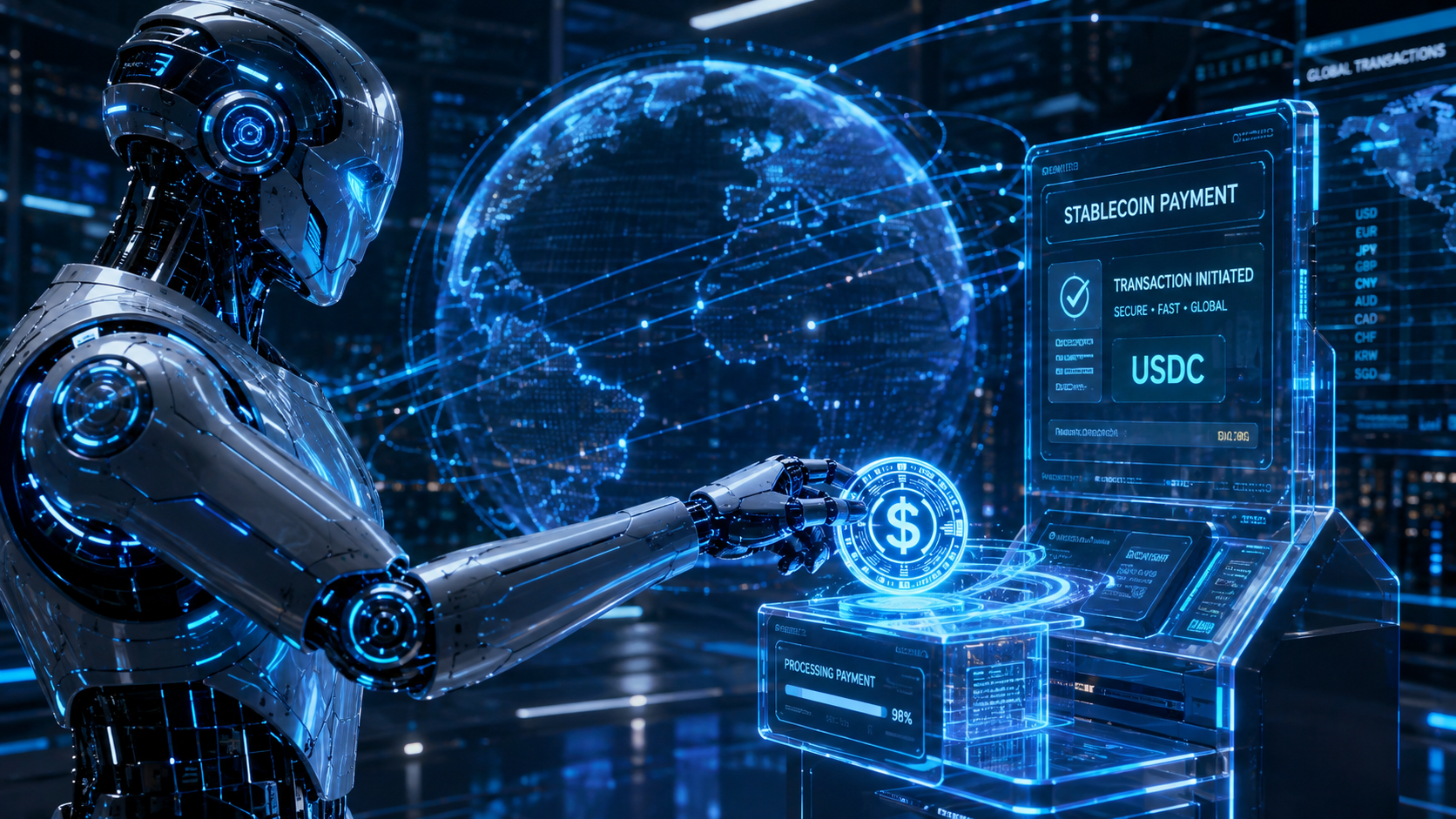
Visa and Dunamu, the parent company of South Korean crypto exchange Upbit, are teaming up to explore how stablecoins could be used for payments, international transfers and settlement across major markets. 🌍 The partnership combines Dunamu’s digital asset infrastructure with Visa’s huge global payments network, with several stablecoin models under consideration, including the proposed dollar backed OUSD. 💵
The companies are also looking beyond human shoppers and into agentic commerce, where AI assistants could search for products, choose services and eventually make payments on our behalf.
Stablecoins could become especially useful here because software does not particularly enjoy waiting for banks to open on Monday morning. 😄The project is still exploratory rather than a finished consumer product, but it shows how AI, stablecoins and traditional payment networks are increasingly starting to meet in the same financial ecosystem. 🔗
Revolut has started rolling out EURR, its first euro backed stablecoin, to selected customers in Denmark, Poland and Portugal, with more European Economic Area markets expected to follow. 🇪🇺 The token is issued by Stripe owned Bridge Building, is designed to maintain a value of one euro and is backed by reserves managed in line with Europe’s MiCA framework.
🛡️ EURR launches first on Ethereum and is intended to work not only inside Revolut but also with external wallets and additional blockchain networks as the rollout develops. ⛓️ The move is particularly interesting because Revolut already sits between everyday banking and crypto, meaning stablecoins are becoming less of a specialist crypto product and more of a normal financial feature.
📱And with stablecoins tied to other currencies already being developed, EURR looks more like the first chapter than a one off experiment. 🚀
The London Stock Exchange and Kraken parent Payward are reportedly working together to bring tokenized exposure to major UK equities to LSE 24, the exchange operator’s new near continuous trading venue. 🇬🇧 The initiative is expected to begin in 2027 and could give investors access to blockchain based representations of British stocks for much longer than traditional market hours.
⏰ Tokenization can also support fractional ownership, making assets easier to divide and potentially more accessible to a broader range of investors. 🧩 LSE has separately confirmed that LSE 24 is being designed for trading from Monday to Friday across global time zones, reflecting the increasingly international and automated nature of markets. 🌐Wall Street, the City and crypto platforms may still have different wardrobes, but their infrastructure is starting to look surprisingly similar. 👔
StarkWare researcher Avihu Levy has successfully tested an experimental quantum resistant Bitcoin transaction on the mainnet, demonstrating that one form of safer spending can work without changing Bitcoin’s existing consensus rules. ₿
The Quantum Safe Bitcoin method uses hash based one time signatures and computational work designed to remain secure even if future quantum computers become capable of breaking the elliptic curve cryptography currently used by Bitcoin.
🧠 That sounds like science fiction, but researchers are already preparing because sufficiently advanced quantum machines could eventually create a serious security problem for exposed Bitcoin public keys.
⚠️ There are some large practical limitations today, as producing the transaction required hours of computation, cost roughly $150 to $200 and needed direct submission to a miner because standard Bitcoin nodes would not relay it. 💻 So nobody needs to replace their laptop with a quantum bunker just yet, but the experiment is an interesting safety net while developers work on broader protocol level protections. 🛡️
Webull is expanding its Canadian investment platform into cryptocurrency trading, with Coinbase providing the underlying trading and custody infrastructure. 🇨🇦 Canadian users will now be able to access digital assets including Bitcoin, Ether and Solana alongside stocks, ETFs and options from the same broader investment environment.
📊 The expansion arrives as crypto ownership in Canada continues to grow, with research cited by Webull indicating that ownership has increased substantially compared with 2023. 📈 At the same time, Canadian policymakers are working toward clearer rules for digital assets, including a federal framework for fiat backed stablecoins. ⚖️ In other words, crypto is increasingly becoming another tab in the brokerage app rather than an entirely separate financial universe. 😄
Better Mortgage and Coinbase have made a Bitcoin backed mortgage product broadly available in the United States, allowing eligible buyers to use BTC as collateral for a home down payment without first selling it.
🏡 The structure combines a Fannie Mae backed mortgage with a separate down payment loan, with borrowers required to provide Bitcoin worth at least 250% of the value of that second loan.
🔐 Interestingly, normal Bitcoin price fluctuations alone do not trigger margin calls or change the mortgage terms, although Better may liquidate the collateral if the borrower becomes seriously delinquent on payments. 📉
The BTC is held in Better’s custodial account on Coinbase Prime and is returned after the mortgage is repaid or refinanced according to the loan terms. 🔄 It is a very literal example of crypto moving into everyday finance, because apparently Bitcoin can now help you get both a digital wallet and an actual front door. 🔑
Virtu Financial, M1X Global and Tradeweb have completed an institutional repo transaction using a sovereign digital bond as collateral, with the entire process settled on the Canton Network.
🔗 The collateral was USDM1, a dollar denominated digital bond issued by the Republic of the Marshall Islands and backed one to one by short term US Treasurys. 💵 What makes the transaction notable is that the bond was not simply issued or traded onchain, but actively used as collateral in a financing transaction between regulated counterparties.
🏛️ The complete repo and repurchase cycle reportedly took less than ten minutes, offering a glimpse of how blockchain infrastructure could make traditionally complex capital market processes much faster.
⚡ It remains an early example rather than proof that the global repo market is suddenly moving onchain, but this is exactly the sort of less glamorous infrastructure experiment that could eventually matter a lot. 🔧

Stablecoin payments company KAST has launched KAST Business, a platform combining business accounts, payment cards, international transfers and yield bearing balances using stablecoin infrastructure.
Companies can receive money through fiat virtual accounts supplied by regulated partners, deposit supported digital assets, issue virtual cards and make local payouts in more than 20 currencies. 💳 KAST also advertises yields of up to 8% on idle balances and cashback of up to 3%, although the company itself is a fintech provider rather than a bank and regulated services come through licensed partners.
🏦The launch follows an $80 million funding round that reportedly valued KAST at $600 million, with the company now targeting between 1,000 and 5,000 active business customers by the end of 2026.
📈 Stablecoins are clearly trying to move beyond crypto trading and into the far less glamorous world of invoices, payroll and business payments, which may actually be where things get interesting. 😄
Ripple Prime has launched a Delta One business that gives institutional investors exposure to derivatives linked to US listed equities, indexes and digital assets. 🏦 Clients can use total return swaps, meaning they can gain exposure to an asset’s performance without directly owning the underlying stock or digital asset.
📈 Ripple says the service also allows institutional customers to work with one counterparty and cross margin positions across several asset classes, including around the clock digital asset markets. 🔄 The expansion follows Ripple’s $1.25 billion acquisition of prime broker Hidden Road in 2025, which was subsequently rebranded as Ripple Prime.
This is another sign that large crypto companies are increasingly moving horizontally into services traditionally dominated by investment banks and prime brokers, so the crypto versus TradFi border continues to become wonderfully blurry. 🌫️
South Korean financial giant Mirae Asset reportedly plans to build a digital asset business worth as much as 150 trillion won, around $109 billion, around its newly acquired crypto platform Digital X. 💰
The strategy stretches well beyond cryptocurrency trading and includes stablecoins, real world assets and security token offerings. ⛓️ Mirae is also considering tokenizing physical assets such as gold, silver and even electricity, illustrating just how broad the definition of an investable digital asset is becoming. ⚡ Digital X is the rebranded Korbit exchange, which Mirae Asset Consulting took control of after acquiring a 97.15% stake earlier this year. 🏦 The ambition is enormous compared with Digital X’s current market position, so the next challenge will be turning a very large vision into actual products, liquidity and users. 👀
A new survey from the National Institute on Retirement Security found that 77% of Americans consider cryptocurrency in workplace retirement plans risky, including 46% who describe it as very risky. 📉
More than half of respondents also oppose employers offering crypto as an investment option, suggesting that mainstream acceptance still has some distance to travel when retirement savings are involved. 🏦 The hesitation comes amid broader financial anxiety, with 80% of respondents saying the United States faces a retirement crisis and 68% saying it is becoming harder to prepare financially for retirement. 💸
Meanwhile, US policymakers and regulators have been considering ways to broaden access to alternative investments in workplace retirement plans while keeping responsibility for risk assessment with plan fiduciaries. ⚖️ Crypto may be welcome in trading apps, payment systems and portfolios, but when the money is meant to fund life at 70, Americans apparently prefer a little less roller coaster. 🎢
Charles Schwab plans to expand its direct cryptocurrency trading service by adding Solana, Avalanche and Chainlink alongside Bitcoin and Ether. 📱 Schwab Crypto only began rolling out to retail clients in May, so the move suggests the brokerage is already comfortable widening its digital asset offering. 🚀
Clients can access crypto alongside more traditional investments through Schwab’s existing website, mobile app and thinkorswim platform, helping digital assets blend into the normal brokerage experience. 📊
The service currently charges a 0.75% fee on each crypto trade and is available across most US states, although New York and Louisiana remain excluded. 🇺🇸 With Schwab managing more than $13 trillion in client assets, even a relatively cautious expansion is another reminder that crypto access is steadily becoming part of mainstream financial platforms. 🌐
BitGo has acquired NYDIG’s institutional trading business, expanding its capabilities in derivatives, structured products, financing and capital markets services. 📈 Around 30 NYDIG employees are joining BitGo as part of the deal, together with the acquired unit’s institutional trading relationships. 👥
The acquisition strengthens BitGo’s position as it tries to offer a broader package of crypto services to asset managers, hedge funds and corporate clients rather than focusing mainly on custody infrastructure. 🏛️ NYDIG, meanwhile, plans to concentrate more of its resources on areas such as power generation, Bitcoin mining and high performance computing data centers. ⚡ No financial terms were disclosed, but the direction is clear: BitGo wants more pieces of the institutional crypto stack under one roof, because apparently custody alone was not enough paperwork. 😄
Bitfinex Securities has completed a $50 million tokenized capital raise for metals company Alkemya, the largest fundraising round conducted on the platform so far. 💰 Investors purchased ALKN, a tokenized security representing interests in a Luxembourg partnership that owns approximately seven million meters of ultra pure nickel wire valued by the companies at around $1.64 billion. 🏭
The structure gives eligible investors fractional and digitally transferable exposure to the partnership while allowing Alkemya to raise capital against a physical industrial asset. 🔗 The proceeds are expected to support development of engineered nickel products for sectors including semiconductor manufacturing. 💻
Tokenization has spent years promising that almost anything can move onchain, and seven million meters of nickel wire is a rather convincing way of saying “yes, we meant anything.” 😄
French Bitcoin treasury company Capital B has raised €21 million, roughly $24.5 million, through a private share placement and plans to use the proceeds to purchase another 270 BTC. 🇫🇷 The financing attracted participants including Bitcoin pioneer Adam Back and asset manager TOBAM, while the attached warrants could potentially generate significantly more capital if exercised. 📈 Buying the planned 270 Bitcoin would increase Capital B’s holdings to approximately 3,415 BTC, continuing its strategy of building Bitcoin into the center of its corporate treasury. 🏦
The company is pressing ahead even as some smaller Bitcoin treasury businesses have started reducing holdings amid less certain market conditions. 🌦️ It is another example of the corporate Bitcoin strategy refusing to disappear quietly, although shareholders still need to remember that increasing the BTC stack can also mean increasing financial exposure and dilution. ⚖️

Circle has become a principal partner of Chelsea FC, with the Circle and USDC brands set to appear on the front of the club’s men’s, women’s and academy shirts from the 2026 to 2027 season. 🔵 The timing is particularly interesting because the UK Financial Conduct Authority warned football clubs only a few months earlier about sponsorship arrangements involving unauthorized financial firms, including some crypto businesses. ⚠️
However, the FCA later clarified that a lack of authorization does not automatically mean a sponsorship is unlawful, while Circle’s UK entity is authorized for certain financial services and Circle describes the Chelsea arrangement as brand sponsorship rather than a financial promotion. ⚖️ Circle also explicitly notes that USDC itself is not issued or regulated under UK law, an important distinction as the country continues developing its stablecoin framework. 🏛️
So yes, stablecoins have officially made it from blockchain conferences to Premier League shirts, but this partnership also shows why compliance language is now almost as important as the logo itself. 👕
Thirty nine US state banking associations have joined forces to create the BankChain Alliance, with plans to launch a nationwide blockchain network for banks in 2027. 🇺🇸 The industry owned and industry governed network is designed to support tokenized deposits, stablecoins, smart payment tools and automated settlement while keeping these services inside the regulated banking system. 🔗 One important goal is to give smaller and regional banks access to blockchain infrastructure without forcing every institution to build its own expensive system from scratch. 🏗️ The project is still at an early stage, however, as BankChain has not yet selected its technology partner and has not announced which individual banks will actually participate. 👀 It also enters an increasingly crowded space, with major US banks already supporting separate initiatives for tokenized deposits and onchain settlement. 💵 Blockchain was once supposed to replace the banks, and now the banks are apparently building their own blockchain together, which is quite the plot twist. 😄
World Liberty Financial has launched its USD1 stablecoin natively on the Canton Network, giving institutions another digital dollar option for settling transactions involving tokenized real world assets. 💰 Because USD1 now exists directly on Canton, it can serve as the cash side of transactions involving asset issuance, redemptions, institutional lending and derivatives collateral without requiring the payment leg to move elsewhere. 🔄 Canton’s privacy and permissioning features are particularly important here, as institutional financial transactions usually need much more control over who can see and access data than typical public blockchain activity. 🔐 USD1 is issued by BitGo Bank & Trust and currently has a market capitalization of roughly $4 billion, making it one of the largest stablecoins in the market. 📊 Canton says its ecosystem already processes or issues more than $9 trillion in tokenized assets each month, so adding a native dollar settlement asset could make those markets more practical to operate entirely onchain. 🌐 Tokenizing the asset was only half the puzzle, and now the industry is increasingly trying to make sure the money paying for it can travel at the same speed. ⚡
Swiss digital asset infrastructure company Taurus has integrated its custody and tokenization platforms with Swift’s new blockchain based shared ledger. 🔗 The connection allows financial institutions already using Taurus infrastructure to access bank issued tokenized deposits and participate in 24/7 cross border payment workflows without rebuilding their digital asset systems from the ground up. 🏦 Taurus said its first client connections were expected within days of the announcement, with the first DLT transactions through its platforms planned within weeks. 🚀
Swift’s ledger itself is already moving beyond experimentation, with 17 banks across six continents preparing to pilot live tokenized deposit transactions. 🌐 Importantly, the blockchain acts mainly as an orchestration layer that coordinates payment commitments, while final settlement can still take place through familiar systems such as real time gross settlement infrastructure. 🔄 In other words, Swift is not throwing the old financial plumbing away, it is adding a rather futuristic new pipe next to it. 😄
Japan is reportedly studying a blockchain based settlement infrastructure that could allow stock and government bond transactions to settle in cash immediately and potentially operate around the clock. 🌙 The Financial Services Agency, Ministry of Finance, Bank of Japan and financial institutions are expected to work together on the concept, with a development plan targeted for early 2027. 🏛️
One particularly interesting idea is to convert part of the deposits banks hold in Bank of Japan current accounts into digital tokens that could be used for interbank settlement on blockchain infrastructure. 💴 That could eventually enable delivery versus payment to happen much more quickly, compared with Japan’s current T+2 settlement cycle for equities and T+1 for domestic government bonds. ⚡ The Bank of Japan is already exploring the technical feasibility of tokenizing central bank reserves through an internal sandbox, although any full system would likely not arrive before the early 2030s. 🧪 So this is definitely not an overnight upgrade, but Japan is clearly investigating whether the financial market of the future should have fewer waiting rooms. 😄
Economists at the Federal Reserve Bank of Dallas have warned that tokenized deposits could make banking faster and more programmable while also making deposits less stable as a source of funding. ⚠️ If customers can instantly move money between banks in search of better interest rates, especially with AI agents eventually automating those decisions, deposits could become much more sensitive to small changes in returns. 🤖 The economists estimated that a 10% increase in deposit sensitivity to interest rates could reduce banks’ capacity to hold long term loans and similar assets by about $700 billion in 10 year equivalent terms. 📉
In another scenario, shortening the average time deposits remain at banks by 10% could reduce that capacity by roughly $580 billion, although the researchers stress that these are scenarios rather than forecasts and do not mean lending would fall dollar for dollar. 📊 Banks could compensate by holding more liquid assets or relying more heavily on longer term wholesale funding, but that funding is typically more expensive and could eventually increase borrowing costs for households and companies. 💸 Instant money sounds excellent until your deposit decides to shop around for a better rate before you have finished your morning coffee. ☕
The UK government plans to give the Bank of England a new secondary objective to support innovation in payment systems and emerging forms of digital money, including stablecoins. 🇬🇧 Financial stability will remain the central bank’s primary responsibility, but the new mandate is designed to ensure regulation does not unnecessarily hold back technologies such as tokenization and distributed ledger based payments. 🔗 The change would extend an innovation objective already used in parts of financial market infrastructure regulation to systemic payment systems and digital settlement assets. 🏦
Under the proposal, the Bank of England would also report annually to Parliament on how it is supporting innovation, adding a little more accountability to the process. 📋 The announcement comes as the UK continues developing its stablecoin framework and experimenting with technologies including tokenized markets, cross border stablecoin payments and a potential digital pound. 💷 It is essentially the regulatory version of saying “please innovate, but maybe keep both hands on the steering wheel.” 😄
The Monetary Authority of Singapore is reconsidering how foreign issued stablecoins could fit into its regulatory framework, potentially making its rules more international than originally planned. 🌏 Under one proposal, stablecoins jointly issued by companies in Singapore and another jurisdiction could qualify as MAS regulated stablecoins if the associated regulatory and operational risks are properly addressed. 🛡️
MAS is also considering recognizing a limited number of stablecoins issued entirely overseas when they operate under regulatory regimes considered sufficiently comparable to Singapore’s own standards. 🌐
This represents a notable shift from the framework announced in 2023, when qualifying stablecoins were generally expected to be issued solely in Singapore. 🔄 The wider proposal also includes requirements covering reserve assets, capital, redemption at par, customer money protection, stress testing and recovery plans, while regulated issuers would not be allowed to pay interest directly on stablecoin holdings. 💰 Singapore is therefore not exactly opening the stablecoin doors and throwing away the keys, but it may be preparing to let carefully checked international guests inside. 🚪
Thailand’s Securities and Exchange Commission has proposed allowing retail investors to access certain regulated cryptocurrency derivatives traded on overseas exchanges.
🌍 Eligible products would need to resemble crypto derivatives permitted in Thailand in areas such as their underlying assets, maturity, leverage and settlement mechanisms. 📊 They would also need to trade on qualifying exchanges that use central counterparties for clearing and are supervised by regulators belonging to recognized international regulatory groups. 🛡️ Products that do not meet those conditions would remain available only to institutional investors, who the SEC considers better equipped to evaluate more complex risks. 🏦
The proposal follows Thailand’s broader effort to bring digital assets into regulated capital markets, including recognition of cryptocurrencies as permissible derivatives underlyings and separate work on Bitcoin and Ether ETF rules. ₿ The consultation remains open until September 30, so Thai retail investors are not getting a global crypto derivatives button tomorrow, but the door is clearly being examined. 🚪

Caterpillar is applying lessons from decades of mining automation to a much broader challenge: making AI genuinely useful in factories, construction sites and everyday industrial operations. 🏗️ The company already operates an enormous digital foundation of around 1.6 million connected assets producing more than 16 petabytes of structured data, which now feeds tools such as the Cat AI Assistant. 📊
Technicians can use voice commands to find repair procedures, diagnose equipment problems and identify required parts while standing next to a machine, rather than digging through thousands of pages of manuals. 🔧 Caterpillar is also using AI for digital twins, site scanning, software development and autonomous equipment, while experienced machine operators help teach the systems how real jobs are actually performed. 🧠
The company plans to invest $100 million over five years in training its 118,000 employees in AI, autonomy and robotics, highlighting that deploying AI is as much an organizational challenge as a technical one. 🎓 The lesson from mining seems fairly simple: buying clever technology is the easy part, getting humans, machines and workflows to cooperate is where the real excavation begins. 😄
Google is turning AI Mode in Search into something increasingly similar to a conversational travel assistant, adding flight price tracking, hotel booking and rewards based travel search. 🌍 Users can describe their destination, dates and preferences in normal language, and Google can compare current prices from more than 300 airlines and travel websites before building possible itineraries. ✈️ If the fare feels a little too painful, users can ask AI Mode to monitor it and receive an email when the price changes, with flight tracking now available in more than 180 countries. 📉
The service can also show how many airline miles or loyalty points are needed for flights and hotels, while hotel booking is starting in the US through partners including Booking.com, Expedia, Hilton and Marriott. 🏨 Google does not actually become the hotel operator, as bookings and customer service remain with the travel provider, but AI Mode is clearly moving from simply answering questions toward helping complete transactions. 💳 So the traditional holiday ritual of opening 37 browser tabs may finally be facing some serious technological competition. 😄
Instagram is introducing tougher rules for profiles built around people who are generated or substantially created with artificial intelligence. 📱 Its existing “AI creator” label is being renamed “AI generated profile,” making it clearer that the person smiling from the feed may not actually exist outside a GPU. 🤖
Accounts featuring synthetic people that fail to disclose this properly could have their reach reduced, while creators who use the label correctly will not be penalized simply for operating an AI personality. 📉 Importantly, the rule does not apply to every use of AI, so editing a photograph, improving a caption or creating graphics with AI does not automatically turn an account into an AI generated profile. 🎨
Instagram says the change responds to growing frustration from users who discover only later that apparently human influencers are entirely artificial, a problem that becomes especially sensitive when such profiles give health advice or promote products. ⚠️ AI influencers can apparently stay on Instagram, but from now on they may need to bring the digital equivalent of an ID card. 🪪
AI has made creating content incredibly easy, which has created another problem: nobody can remember where all those videos, recordings, images and documents actually went. 😅 Clipto is tackling that problem with software that indexes files on a user’s computer and lets people search through them using natural language, including through AI tools such as ChatGPT and Claude. 🔎 The three year old company has raised $15 million in an all equity round at a $250 million post money valuation, with investors including HSG, GL Ventures and Palm Drive Capital. 💰
Clipto says more than 30 million people have used its products, it has hundreds of thousands of paying subscribers and it reached $15 million in annual recurring revenue at the beginning of 2026 while remaining profitable. 📈 A recent Model Context Protocol integration allows AI assistants to access selected indexed information with user authorization, while Clipto says the underlying processing can remain local on the device rather than being uploaded to the cloud. 🔐 Generative AI gave us the ability to produce mountains of content, and Clipto is betting there is good money in helping us find the one video buried somewhere underneath the mountain. 🏔️
Boston startup Blue Voice has emerged from stealth with $6 million in funding to develop an AI assistant that gives police officers real time access to department rules, laws and operational procedures. 📚 Instead of relying entirely on memory or searching through enormous manuals during an incident, officers can ask a question on their phone and receive relevant guidance linked back to the original regulation.
The company says its system is already used across 225 public safety agencies in 25 US states, with the platform answering roughly one question every minute. 🇺🇸
Blue Voice is designed around department specific information such as local ordinances and internal policies that general purpose chatbots may not have, and the company stresses that its software provides information rather than making the final policing decision. ⚖️ That distinction is particularly important because using AI in law enforcement introduces serious questions around accuracy, accountability, bias and how much responsibility should ever be delegated to software. 🛡️ Calling it a “Harvey for police officers” makes the idea easy to understand, but in this profession a wrong AI answer carries considerably higher stakes than forgetting what was discussed in Monday’s meeting. 😬
Plaud is expanding the increasingly crowded AI note taking market with Plaud One, a pair of wireless earphones designed to record conversations, transcribe them and turn what was said into actual follow up work. 🎧 Its AI software can connect with services including Gmail, Google Calendar, Notion and Slack, allowing a meeting transcript to become an email, document or presentation rather than simply another forgotten recording. 📝 The unusual part is the charging case, which includes eSIM connectivity so users can interact with Plaud’s future AI agents remotely without necessarily reaching for a smartphone or laptop. 📡 Plaud says the earbuds can record up to six hours of meetings or three hours of calls, while the case extends total recording time to around 25 hours and can capture conversations from several meters away. 🔋
The $249 device is initially being released in limited quantities, with shipments planned for the fourth quarter of 2026, suggesting Plaud is also testing just how much demand exists for dedicated AI earphones. 🧪 We have officially reached the stage where even the earbud case wants to join the meeting and prepare the follow up email afterward. 😄
OpenAI is expanding advertising in ChatGPT to India, where ads are being introduced for users on the Free and lower priced Go plans while paid tiers such as Plus and Pro remain ad free. 🇮🇳 The initial rollout involved around 50 brands and partnerships with advertising groups WPP and Omnicom, giving OpenAI another way to monetize one of its largest user markets. 📈 India already had more than 100 million weekly active ChatGPT users according to figures disclosed by OpenAI earlier this year, which makes the country particularly attractive for advertisers.
👥 OpenAI says sponsored items are clearly labeled and kept separate from ChatGPT’s answers, while advertisers do not receive access to users’ private conversations and ads do not determine the assistant’s responses. 🛡️ The expansion forms part of a much broader advertising strategy, with OpenAI announcing at the end of August that ChatGPT Ads had reached a $1 billion annualized revenue run rate and was expanding self service advertising into more regions. 💰 The chatbot may still help you decide what to buy, but now brands would quite like to be standing somewhere nearby when that decision happens. 😄
Bullish is providing USD.AI with a $100 million stablecoin based debt facility designed to finance loans backed by high performance GPUs and other AI computing infrastructure. 🤖 Instead of lending primarily against a company’s overall balance sheet, USD.AI structures non recourse loans where the underlying computing hardware acts as collateral, connecting blockchain liquidity directly with the booming demand for AI infrastructure. 🖥️
The platform has already completed sizeable deals, including a $98.1 million loan secured by 2,304 Nvidia B300 GPUs and another $34 million facility backed by 768 B200 chips. 💰 Bullish also plans to introduce USD.AI’s yield bearing sUSDai token across several trading pairs and provide dedicated market making, potentially improving liquidity and price discovery for this unusual new category of compute backed credit. 📊
USD.AI reported almost $500 million in total value locked by the end of August, showing that the combination of stablecoins, private credit and AI infrastructure is becoming more than a small DeFi experiment. 🔗 GPUs were already chips, infrastructure and one of the hottest commodities in technology, and now apparently they would also like a side career as collateral. 😄
Nvidia has reportedly agreed to acquire Hugging Face for around $12.9 billion, potentially giving the chip giant control of one of the most important distribution and collaboration platforms in open AI. 🤖 Hugging Face hosts an enormous ecosystem of models, datasets and development tools, making it something close to a central meeting place for developers working with open source and open weight AI. 🌐 Strategically, owning the platform could strengthen Nvidia’s relationship with developers and potentially drive even more AI workloads toward its hardware and software ecosystem. 🖥️
At the same time, the idea raises an interesting question because Hugging Face has traditionally positioned itself as a relatively neutral platform supporting models and hardware across different companies, including Nvidia competitors. ⚖️ Reports differ slightly on the status of negotiations, and as of the latest reporting neither Nvidia nor Hugging Face had publicly confirmed completion of the transaction, so the $12.9 billion figure should still be treated as a reported deal rather than a finished acquisition. 👀 If it does close, Nvidia would no longer be satisfied with selling the shovels during the AI gold rush, it would also own a rather important part of the marketplace where everyone chooses their tools. ⛏️
Personal AI assistant startup Instinct has raised a new $250 million Series B round co led by Index Ventures and Benchmark, bringing its total funding to around $350 million and its valuation to $2.5 billion. 💰 The company was founded only in 2025 by Noah Shinn, who is 23, making the speed of its valuation increase almost as eye catching as the product itself. 🚀 Instinct works as a personal AI agent that users can contact through calls or text messages and connect to their apps, allowing it to handle tasks such as travel planning, groceries, concert tickets, subscriptions and calendar management. 📲
Some early users have even used it to help organize weddings, demonstrating the broader industry ambition to turn AI assistants from question answering tools into software that actually performs everyday tasks. 💍 The catch is that this requires extensive access to personal accounts and devices, and Instinct has already attracted concerns about the permissions it requests and how sensitive user information may be handled. 🔐 A $2.5 billion valuation for an assistant still in private beta certainly shows how excited investors are about consumer AI agents, although the agents themselves might soon have to remind investors what the word “patience” means. 😄

